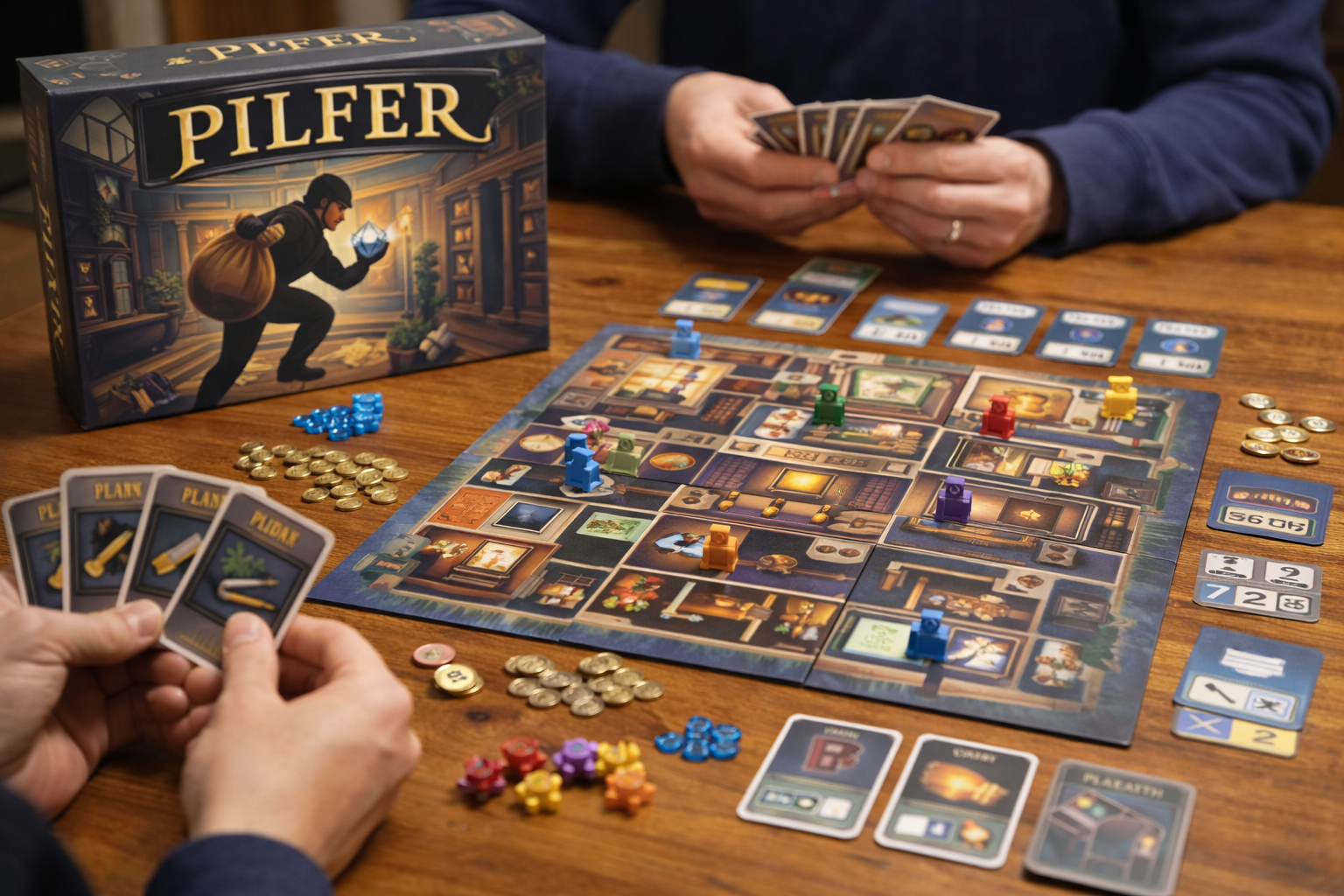
Introduction:
Have you ever played a game where every move feels like a small heist, and every decision could either make you a genius or cost you everything? That’s exactly the thrill behind the Pilfer Game. It’s simple on the surface, yet surprisingly deep once you dive in.
At its core, the Pilfer Game is a strategic game of taking and leaving items from piles. It belongs to a class of mathematical games similar to Nim, where logic, foresight, and pattern recognition play a huge role. What makes it especially interesting is that even though the rules are easy to learn, mastering it takes time, patience, and a sharp mind.
In this detailed guide, we’ll explore everything you need to know—from the basic rules to advanced strategies. Whether you’re a beginner or someone looking to sharpen your skills, this article will give you a complete understanding of the Pilfer Game.
Understanding the Basics of the Pilfer Game
What Is the Pilfer Game?
The Pilfer Game is a two-player strategy game where players take turns removing objects from piles. The objective usually depends on the variation, but most commonly, the player who takes the last item wins.
It may sound simple, but the challenge lies in deciding how many objects to take and from which pile. Each move changes the state of the game, and one wrong decision can hand victory to your opponent.
What makes this game stand out is that it is not based on luck. There are no dice, no random cards, and no hidden information. Everything is visible, which means the game rewards logical thinking and planning ahead.
Basic Rules of the Game
The rules of the Pilfer Game can vary slightly, but the standard version follows a simple structure:
- The game starts with several piles of objects (like stones, coins, or tokens).
- Two players take turns.
- On each turn, a player can remove one or more objects from a single pile.
- The player who removes the last object wins.
This setup may remind you of classic strategy puzzles, and that’s exactly where its roots lie.
Why It’s Easy to Learn but Hard to Master
At first glance, the Pilfer Game feels straightforward. You just take items until nothing is left. However, after a few rounds, patterns begin to emerge.
You start realizing that some positions are “safe” while others are dangerous. A single move can shift the balance completely. This is where the game transforms from simple fun into a deep strategic experience.
The Origins and Mathematical Roots of Pilfer
Connection to Classic Mathematical Games
The Pilfer Game is closely related to the mathematical game Nim. In fact, many versions of Pilfer are inspired directly by Nim’s structure.
In Nim, players remove objects from piles, and the key to winning lies in understanding binary patterns. Pilfer adopts a similar concept but often introduces small twists that make it unique and engaging.
These games have been studied by mathematicians for decades. They are often used to teach concepts like combinatorics, game theory, and logical reasoning.
The Role of Game Theory
Game theory plays a huge role in understanding the Pilfer Game. Every move has consequences, and the goal is to force your opponent into a losing position.
A “winning position” is one where, with perfect play, you can guarantee victory. A “losing position” is one where no matter what you do, your opponent can outplay you.
The beauty of the Pilfer Game lies in identifying these positions and navigating the game toward them.
Why Mathematicians Love It
Mathematicians love games like Pilfer because they are deterministic. There’s no randomness involved, which means outcomes can be predicted with perfect play.
This makes the game an excellent tool for studying strategy, logic, and problem-solving. It’s not just a game—it’s a mental exercise.
Setting Up the Pilfer Game
Choosing the Number of Piles
You can start with any number of piles, but beginners usually begin with three. Each pile can have a different number of objects.
For example:
- Pile A: 3 objects
- Pile B: 5 objects
- Pile C: 7 objects
This setup creates enough complexity without overwhelming new players.
Selecting Objects
The objects themselves don’t matter. You can use coins, stones, candies, or even small household items.
The key is that they are easy to count and remove. Many players prefer using identical objects to avoid confusion.
Deciding the First Player
The first move can be a significant advantage or disadvantage depending on the setup.
In some variations, players flip a coin to decide who goes first. In others, the starting player is predetermined.
Core Strategies for Winning
Understanding Safe Positions
One of the most important concepts in the Pilfer Game is the idea of safe positions.
A safe position is one where no matter what your opponent does, you can respond in a way that keeps you in control.
These positions often follow specific patterns. Once you recognize them, you can guide the game toward them.
The Power of Balance
A common strategy is to balance the piles in a way that mirrors your opponent’s moves.
If your opponent removes objects from one pile, you make a move that restores balance. This forces them into a cycle where they cannot gain an advantage.
This approach requires careful observation and quick thinking.
Thinking Ahead
Winning the Pilfer Game is all about thinking several moves ahead.
Instead of focusing on your current move, ask yourself:
- What options will my opponent have next?
- Can I force them into a weak position?
- How can I control the endgame?
The more you practice, the better you’ll become at predicting outcomes.
Advanced Techniques and Expert Tips
Binary Thinking
Advanced players often use binary calculations to determine winning moves.
Each pile size can be converted into binary numbers. By analyzing these numbers, you can identify optimal moves that guarantee victory.
While this may sound complicated, it becomes intuitive with practice.
Controlling the Endgame
The endgame is where matches are won or lost.
If you can reach a position where only a few objects remain, you should already know the exact sequence of moves needed to win.
Experienced players often plan for the endgame from the very beginning.
Psychological Play
Even though the game is logical, psychology still plays a role.
If your opponent is inexperienced, they may not recognize optimal strategies. You can use this to your advantage by making moves that seem harmless but lead them into traps.
Confidence and composure also matter. Staying calm helps you think clearly and avoid mistakes.
Common Mistakes Beginners Make
Playing Randomly
One of the biggest mistakes is playing without a plan.
Beginners often remove objects randomly, hoping for the best. This approach rarely works against a skilled opponent.
Ignoring Patterns
Patterns are the backbone of the Pilfer Game.
If you ignore them, you miss opportunities to control the game. Learning to recognize patterns is essential for improvement.
Focusing Only on the Present
Many players focus only on the current move instead of thinking ahead.
This short-term thinking can lead to poor decisions. Always consider the long-term impact of your moves.
Variations of the Pilfer Game
Misère Version
In this variation, the player who takes the last object loses instead of winning.
This small change completely alters the strategy and forces players to rethink their approach.
Limited Removal Rules
Some versions restrict how many objects can be removed in a single turn.
For example, you might only be allowed to remove up to three objects per move. This adds another layer of complexity.
Multi-Player Versions
While the classic Pilfer Game is designed for two players, it can be adapted for more.
However, adding players changes the dynamics significantly and requires new strategies.
Benefits of Playing the Pilfer Game
Improves Logical Thinking
The pilfer game trains your brain to think logically and strategically.
You learn to analyze situations, predict outcomes, and make calculated decisions.
Enhances Problem-Solving Skills
Each move presents a new problem to solve.
Over time, you develop a structured approach to tackling challenges, which can be useful in real life.
Great for All Ages
The Pilfer Game is suitable for players of all ages.
Children can enjoy its simplicity, while adults can appreciate its depth.
How to Practice and Improve
Play Regularly
The best way to improve is through practice.
Each game teaches you something new, whether it’s a strategy or a mistake to avoid.
Study Winning Patterns
Spend time analyzing games and identifying winning positions.
This helps you build a mental library of strategies.
Challenge Strong Opponents
Playing against skilled players pushes you to improve.
You’ll learn new techniques and refine your skills faster.
Conclusion:
The Pilfer Game is more than just a simple pastime. It’s a fascinating blend of logic, strategy, and mental challenge.
At first, it may seem like a basic game of removing objects. However, as you continue playing, you’ll discover layers of depth that keep you engaged.
Whether you’re looking to sharpen your mind, enjoy a competitive challenge, or simply pass the time in a meaningful way, the Pilfer Game delivers on all fronts.
So, the next time you see a few piles of objects, ask yourself—can you outthink your opponent and claim victory?